Project Overview
The SRE Agent is an autonomous multi-agent system designed to automate Incident Response in Kubernetes environments. By leveraging Large Language Models (LLMs) and a Divide & Conquer strategy, it significantly reduces the Mean Time to Resolution (MTTR) for complex microservice faults.
This system integrates with AIOpsLab for realistic fault injection and uses a custom Model Context Protocol (MCP) server to interface with observability tools (Prometheus, Jaeger, Kubernetes API) securely and efficiently.
Architecture & Key Features
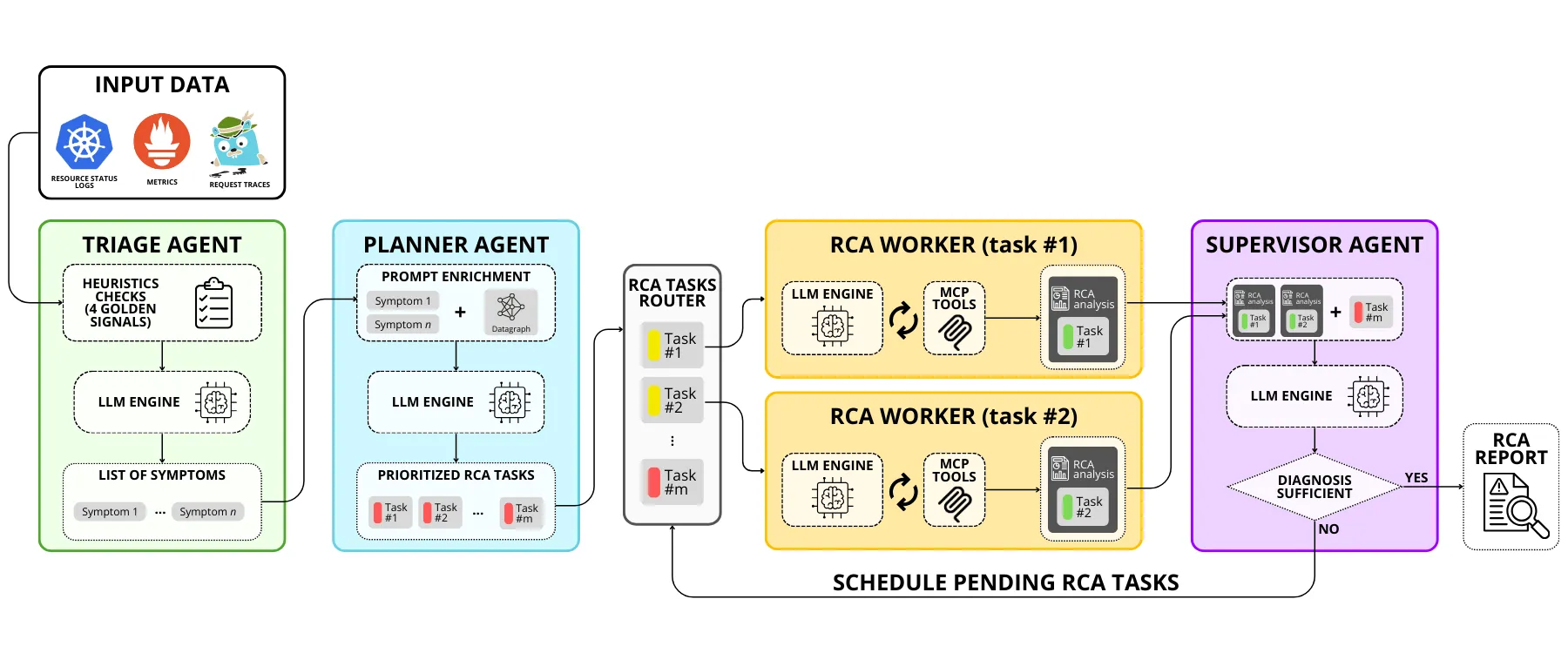
The agent implements a parallel multi-agent workflow to diagnose faults efficiently.
Core Components
- Triage Agent (Hybrid): Detects symptoms explicitly. It combines deterministic heuristics (based on the Four Golden Signals: Latency, Errors, Saturation) with LLM reasoning. This hybrid approach grounds the diagnosis in hard evidence to minimize hallucinations.
- Planner Agent (Topology-Aware): Strategies the investigation. Uses a Graph-Based Datagraphto understand cluster topology (dependencies, upstream services). It generates a deduplicated, prioritized list of RCA Tasks, assigning specific investigation goals and target resources.
- RCA Workers (Parallel Execution): Execute the investigation using a Divide & Conquerapproach. Multiple workers run in parallel, each handling a specific task. They use MCP tools (Logs, Traces, Metrics) to gather evidence and produce a diagnostic report. A deterministic RCA Router manages task dispatching.
- Supervisor Agent: The Final Decision Maker. Aggregates worker reports to synthesize a final Root Cause Analysis. It can either finalize the diagnosis or trigger a feedback loop to schedule pending tasks if more evidence is needed.
Key Features
- Datagraph: A graph representation of the cluster topology (Infrastructure & Data dependencies) that guides the agent, preventing irrelevant resource exploration.
- Custom MCP Server: Standardizes tool interaction and performs “pre-digestion” of data (e.g., retrieving only relevant metrics or error logs) to optimize context window usage and reduce token costs. That server grew into a project of its own: see K8s Observability MCP server for the full tool surface it exposes.
Automated Evaluation Pipeline
The repository includes a robust pipeline for automated experimentation and benchmarking.
Framework
- Integration: Built on top of AIOpsLab to deploy testbeds (Hotel Reservation, Social Network) and inject realistic faults (Network delays, Pod failures, Misconfigurations).
- Batch Execution:
automated_experiment.pyorchestrates end-to-end batch runs: Cluster Setup → Fault Injection → Agent Execution → Evaluation → Cleanup.
Metrics
The system is evaluated on:
- Detection Accuracy: Correct identification of an anomaly.
- Localization Accuracy: Correct identification of the root cause resource (Service/Pod).
- RCA Score: Semantic evaluation of the diagnosis using LLM-as-a-Judge (1-5 scale with rationale).
Repository Structure
SRE-agent/
├── sre-agent/        # Main Multi-Agent System implementation (LangGraph)
├── MCP-server/       # Custom Model Context Protocol server for observability tools
├── notebooks/        # Jupyter notebooks for analysis and development
├── Results/          # Experiment outputs, logs, and reports
├── archive/          # Archive of previous project iterations
└── assets/           # Diagrams and static assets
Links & Resources
- GitHub Repository: Complete source code and implementation.
- K8s Observability MCP server: The observability tool layer this agent calls.